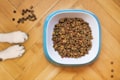



The World's Most Valuable Dog Food
In 2002, a couple in Mount Maunganui invented a new way to dry meat. Twenty years later, a Hong Kong private equity firm bought their company for NZD 1.5 billion — at 30 times revenue. The secret wasn't the recipe. It was two words on the label: New Zealand.
In 2002, Peter and Kimberley Mitchell were running a small business in Mount Maunganui, on the Bay of Plenty coast, trying to solve a problem that had been bothering the premium pet food industry for years. Freeze-drying preserved nutrition beautifully but carried rehydration and bacterial risks in the field. Kibble was shelf-stable and convenient but destroyed nutrition at the high temperatures required for extrusion — typically 120 to 180 degrees Celsius, at which point proteins denature and B vitamins degrade significantly. What was between them? The Mitchells developed a dual-zone air-drying process they called Z-TWINTECH, which used gentle, controlled airflow to reduce moisture to below 15 percent without heat damage. They launched ZIWI Peak in 2004.
What air-drying actually does
The science of Z-TWINTECH sits between the two established preservation methods. Kibble extrusion operates at temperatures that denature proteins and degrade heat-sensitive vitamins — particularly the B-vitamin group. Freeze-drying preserves nutrition more completely, but creates a product that must be rehydrated before feeding and that can, if improperly handled, rehydrate in ways that support bacterial growth. Air-drying at low temperatures preserves the amino acid profile of the meat, retains heat-sensitive vitamins, and produces a product with a moisture content low enough to inhibit microbial growth without refrigeration. It costs considerably more than either alternative — but commands a price premium that makes the economics work.
The factory and the cyclone
ZIWI opened a USD 52 million purpose-built production facility at Awatoto, in Hawke's Bay, in 2020. The timing was significant: the factory was designed around Z-TWINTECH at industrial scale, positioned on the Hawke's Bay plains close to the pastoral farming supply it depended on. In February 2023, Cyclone Gabrielle made direct landfall over Hawke's Bay — one of the most damaging weather events in New Zealand's recorded history. The Awatoto facility was directly in the path of the floods. ZIWI recovered operational capacity within five months. By the time of the most recent MPI data, ZIWI represented over 50 percent of all New Zealand pet food exports by value, supplying more than 35 international markets.
Why a Hong Kong firm paid 30 times revenue
FountainVest Partners, a Hong Kong-based private equity firm, acquired ZIWI in September 2021 for NZD 1.5 billion. By the reporting at the time of the acquisition, ZIWI's annual revenue was approximately NZD 50 million — making the purchase price roughly 30 times revenue. That multiple is extraordinary by any standard. It reflected not just the company's financial performance but its strategic position in the Chinese premium pet food market, where ZIWI's New Zealand provenance had become a significant commercial asset. At its China revenue peak, ZIWI generated NZD 134.3 million from that single market. The 'clean-green New Zealand' story was not merely marketing: it was a food safety signal to a Chinese middle class that had experienced the 2008 melamine scandal and had developed deep suspicion of domestically produced pet food.

K9 Natural: the freeze-dried challenger
K9 Natural was founded in April 2006 by Geoff Bowers, a former British police dog handler, and Bruce Mayhew. The company produces freeze-dried and frozen raw pet food using human-grade New Zealand meat — venison, lamb, beef, chicken — and exports between 80 and 98 percent of its production to 18 international markets, with Japan and the United States as its largest customers. Like ZIWI, K9 Natural's commercial proposition is inseparable from its country of origin. The New Zealand provenance is not incidental; it is the product.
The company that made possum premium
NZ Natural Pet Food Co was founded in 2016 by Jacqueline Taylor and Amber Cordero, producing WOOF and MEOW branded products using wild venison, wild goat, and wild brushtail possum. The company holds more than 30 products licensed under the FernMark programme and exports to 12 countries, including more than 350 stores across the United States. When the company first launched in Singapore, it sold out within two weeks.
The macro picture: a NZD 260 million industry
The USA overtook China as the largest destination market for NZ pet food in 2024 — a significant structural shift in the export profile.
NZ exports at four times the per-kilogram value of Thailand — the world's largest volume pet food exporter — demonstrating the commercial power of provenance.
The regulatory gap nobody talks about
There is a gap in the New Zealand pet food story that the industry does not advertise. There are no mandatory nutritional standards for pet food sold domestically in New Zealand equivalent to the AAFCO (Association of American Feed Control Officials) standards used in the United States. MPI regulates export safety — pathogen levels, labelling, traceability for export products — but does not mandate nutritional adequacy for products sold in the New Zealand domestic market. What 'clean-green New Zealand provenance' guarantees is safety of origin, not nutritional completeness. Those are different things.
The MPI Situation and Outlook for Primary Industries report from June 2025 forecast 10 percent growth in New Zealand pet food exports in the 2025–26 year. Exports represent approximately 32 percent of total domestic production — meaning the majority of what New Zealand produces is consumed at home. The USA has overtaken China as the largest single export destination, a structural shift that began in 2023 and consolidated in 2024.
The Mitchells' insight proved correct: a preservation method that costs more can command a price premium sufficient to build a billion-dollar business. FountainVest Partners did not buy a recipe in September 2021. It bought a provenance story — 'New Zealand' — that no marketing budget can replicate, attached to a processing technology that no competitor could trivially copy. The two words on the label did the work.
Sources & references
- MPI — Situation and Outlook for Primary Industries (SOPI), June 2025
- ZIWI — Company history and Z-TWINTECH technology
- FountainVest Partners — ZIWI acquisition, Bloomberg reporting September 2021
- K9 Natural — Company overview
- NZ Natural Pet Food Co — WOOF & MEOW brands
- New Zealand Story — FernMark Licence Programme
OurPetCircle Originals content is researched from the sources above and is queued for editorial review. It is general interest content and not a substitute for advice from your own vet or a qualified professional.


