


A World Written in Smell
A dog's nose isn't a better version of ours — it is an entirely different way of reading the world, one that turns a single sniff into a story of time, distance, and recent memory.
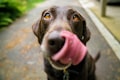
On a Tuesday morning in a park in Singapore, a Labrador named Biscuit stops dead at a lamp post and refuses to move. His owner tugs the lead once, twice. Biscuit does not budge. He is reading.
The lamp post looks, to human eyes, like a lamp post. To Biscuit it is a newspaper, a message board, a forensic database. Urine deposited by seven different dogs over the past eighteen hours encodes their sex, reproductive status, approximate age, emotional state, and the direction each one was heading when it passed. Biscuit is not being stubborn. He is paying attention.
We tend to talk about the canine nose in superlatives — 10,000 times more sensitive than ours, 300 million olfactory receptors versus the human five million. Those numbers are real and they are astonishing, but they risk framing smell as a kind of supercharged version of what we do. Alexandra Horowitz, head of the Dog Cognition Lab at Barnard College and author of "Inside of a Dog," argues for something more radical: that dogs do not merely smell better, they inhabit a different sensory universe entirely — one in which smell is the primary organ of experience and the world is, in effect, written in scent.
“While we might see a face and think we know who a person is, dogs smell a person and know an entire history.”
The Architecture of the Nose
The human nose is, broadly speaking, a delivery mechanism: air comes in, odorant molecules bind to receptor neurons in the olfactory epithelium, and the signal travels to the brain's olfactory bulb. The dog's nose does the same thing, but at a scale that is almost incomprehensible. The olfactory epithelium of a German Shepherd — pleated tightly into a bony labyrinth — covers roughly 170 square centimetres; the human equivalent is about three. The dog's olfactory bulb is, relative to total brain size, about forty times larger than ours.
But raw receptor count is only part of the story. Dogs also possess a second olfactory organ that humans have lost almost entirely: the vomeronasal organ, or Jacobson's organ, a paired fluid-filled sac located at the base of the nasal cavity. Where the primary olfactory system processes volatile airborne chemicals, the vomeronasal organ specialises in heavier, less volatile molecules — pheromones, steroid hormones, the chemical signatures of emotional states. When a dog curls its lip and draws air across the roof of its mouth, it is not making a face. It is loading a second sensor.

Smelling in Time
Here is where the canine olfactory world diverges most strikingly from ours: smell, for a dog, is not just spatial but temporal. Odour molecules evaporate at different rates. A scent trail laid forty minutes ago is chemically different from one laid four minutes ago — and a dog, processing those differences, can reconstruct not just that a person passed but roughly when, and in which direction they were moving (the molecules are more concentrated where the footfall was most recent).
Horowitz calls this "smelling in time." Where our visual world gives us the present moment — a snapshot — the olfactory world a dog inhabits is more like a time-lapse. The park is not a static scene of grass and trees. It is a layered manuscript of recent events, annotated by the metabolic signatures of every creature that has passed through.
What Science Can Detect, Dogs Detected First
The practical implications of canine olfaction have been documented rigorously for decades, but the science keeps delivering surprises. Dogs trained in double-blind protocols have detected early-stage lung, breast, prostate, ovarian, and colorectal cancers from breath, urine, and tissue samples, in some studies achieving sensitivities above 90 per cent. A 2019 study published in the Journal of Urology found that trained dogs could detect prostate cancer in urine with 99 per cent sensitivity and 97 per cent specificity — outperforming the standard PSA test.
More recently, dogs have detected COVID-19 in sweat samples and hypoglycaemia in diabetic patients, often before electronic instruments could. A 2021 study in PLOS ONE by Jess and colleagues confirmed that dogs could identify COVID-19-positive samples with accuracy rates comparable to PCR testing under controlled conditions. The mechanism appears to be the same in all cases: pathological states alter the volatile organic compound profile of bodily fluids, and dogs read that profile with an instrument several orders of magnitude more sensitive than anything currently manufactured.

The Cognitive Question
Knowing that a dog can detect cancer does not tell us what it is like to be a dog smelling cancer. This is the "hard problem" of animal cognition, and it is one the Dog Cognition Lab at Barnard approaches with characteristic care. Horowitz and her colleagues have developed methodologies that observe spontaneous behaviour rather than imposing human interpretive frameworks. Their work on olfactory enrichment — the practice of giving dogs unstructured time to sniff, on their own terms, rather than walking briskly past interesting smells — has changed how many trainers and behaviourists think about exercise. A twenty-minute sniff-led walk, they have found, is more mentally tiring for a dog than an hour of standard on-lead exercise. The sniff is the workout.
Receptor counts are anatomical estimates and vary by study methodology; the relative order is well-established, but exact figures should be treated as illustrative rather than definitive.

What the Lamp Post Knows
Back in the park, Biscuit has finished his reading and moved on, nose still low, mapping the morning. His owner, watching a phone, has not noticed any of it. This asymmetry is, in a way, the thesis of all canine olfaction research: we share the physical space with our dogs, but we do not share the world. They are inhabitants of a sensory environment so rich, so temporally layered and chemically articulate, that the gap between our experience and theirs may be wider than any we share with any other species we have domesticated.
That ought to inspire at least as much awe as a cancer-detection statistic. The dog at the end of your lead is not experiencing a simpler version of what you experience. It is reading a library you cannot open.
Sources & references
- Horowitz A — "Inside of a Dog: What Dogs See, Smell, and Know" (Scribner, 2009)
- Craven BA et al. — "The fluid dynamics of canine olfaction: unique nasal airflow patterns as an explanation of macrosmia" (PLOS ONE, 2010)
- Cornu J-N et al. — "Olfactory detection of prostate cancer by trained dogs" (European Urology, 2011)
- Jess et al. — "Dogs demonstrate detection of SARS-CoV-2" (PLOS ONE, 2021)
- Barnard College Dog Cognition Lab — Alexandra Horowitz
OurPetCircle Originals content is researched from the sources above and is queued for editorial review. It is general interest content and not a substitute for advice from your own vet or a qualified professional.


