
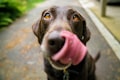




Boxer
Also known as: German Boxer, Deutscher Boxer
An exuberant, playful and people-loving working breed that stays puppyish for years and is famously good with children. Bright, loyal and full of personality, the Boxer is an athletic companion that bonds deeply with its family and brings boundless energy and affection to an active home.
Origin and purpose
The Boxer was developed in Germany in the late 19th century from the now-extinct Bullenbeisser hunting dog crossed with Bulldog stock. Bred as a versatile working dog — for hunting, guarding, cart-pulling and later police and military service — it combines power with agility and an unusually playful character.
Temperament
Breed authorities describe the Boxer as bright, loyal, patient with children and bonded to its people, with a clownish, energetic streak that lasts well into adulthood. Early socialisation and reward-based training channel that energy. As always, breed predicts behaviour only weakly — about 9% of behavioural variation (Morrill et al., Science 2022) — so meet the individual dog.
Health and longevity
The Boxer carries several breed-associated health conditions. Reputable breeders Holter-test and echo the heart and screen hips before breeding.
Common health conditions
Living with a Boxer in Johor Bahru
This section is specific to Johor Bahru (Department of Veterinary Services (DVS Malaysia)). The rest of this guide applies to the breed anywhere.
PSPCA Johor / local JB rescue groups: Not eligible
This breed is not eligible for PSPCA Johor / local JB rescue groups.
Licensing
MBJB dog licence required for JB city (Local Government Act 1976): ~RM 10–50/year; annual rabies vaccination required. Iskandar Malaysia areas: confirm local authority (MPJBT etc.) for your address. Source: MBJB; DVS Malaysia.
Climate & exercise in Johor Bahru
Johor Bahru is equatorial; hot and humid year-round (27–34°C); similar climate to Singapore 1km across the Tebrau Strait; sea breeze at Danga Bay provides relief in mornings and evenings. walk before 8:30am or at Danga Bay waterfront from 5:30pm where sea breeze is consistent; avoid midday — pavement surfaces reach 50°C+ in direct sun. JB's equatorial climate is essentially identical to Singapore's — year-round heat and humidity, with heatstroke risk for brachycephalic and double-coated breeds at any time outside the early-morning window. Cross-border vet access requires DVS and AVS permits (see OurPetCircle JB care guide) — know your local JB emergency vet in advance.
Parasite prevention
Plan for year-round heartworm and tick prevention essential; peri-urban areas (Tebrau, Tampoi, Skudai) adjacent to palm oil plantation and secondary forest have high tick density; Ehrlichia canis and Babesia species documented across Johor; leptospirosis risk in flood-prone residential drains.
Cost of ownership in Johor Bahru
Local Boxer cost figures for Johor Bahru are being verified. Budget for purchase or adoption, initial setup, food, grooming, routine veterinary care, parasite prevention and pet insurance. Figures are quoted in RM.
Health & longevity
Responsible breeders health-test their breeding dogs. Ask to see current certificates before committing.
Nutrition note: Prone to weight gain in middle age; keep lean to protect heart and joints.
Known breed conditions
DNA & screening panel
Cost of ownership
FLAG: indicative Singapore estimate — cardiac monitoring and cancer treatment can raise lifetime cost substantially.
Registries
Sources & references
- AKC — Boxer breed standard & traits[Breed standard / registry]
- The Kennel Club (UK) — Boxer[Breed standard / registry]
- Royal Veterinary College (RVC) — Brachycephaly / BOAS research (VetCompass)[Peer-reviewed / VetCompass / OFA]
- Orthopedic Foundation for Animals (OFA) — breed health screening / CHIC testing[Peer-reviewed / VetCompass / OFA]
- McMillan et al., "Longevity of companion dog breeds…", Scientific Reports 14:531 (2024) — RVC VetCompass life tables[Peer-reviewed / VetCompass / OFA] · 2024
- Merck Veterinary Manual — hereditary and breed-associated disease[Veterinary reference]
- NParks/AVS — Pets in HDB flats (approved small breeds; ≤55 cm shoulder height)[Breed standard / registry] · checked June 2026
- Morrill et al., "Ancestry-inclusive dog genomics…", Science 376 (2022) — breed ≈ 9% of behaviour[Peer-reviewed / VetCompass / OFA] · 2022
Source tiers: 1 = breed standard / registry authority; 2 = peer-reviewed / VetCompass / OFA; 3 = veterinary reference; 4 = encyclopaedic. OurPetCircle cites only tiers 1–4 and never blogs or e-commerce pages. Behavioural traits carry low confidence — breed explains ~9% of individual behaviour variation (Morrill et al., Science 2022).
Image credits
- Image 1: Corporalen · CC0 · via Wikimedia Commons
- Image 2: Jena Fuller · CC BY-SA 2.0 · via Wikimedia Commons
- Image 3: daveynin · CC BY 2.0 · via Wikimedia Commons


